 EVOKE
EVOKE
Eliciting World Knowledge in Agents for Transferable Decision-Making
1Shanghai Jiaotong University 2Eastern Institute of Technology, Ningbo 3Zhongguancun Academy, Beijing, China 4Hong Kong Polytechnic University
 Model
Model
Same state, same actions — only the goal changes, and the preference flips. A policy running on contextual habit ranks them one way under both goals, so it must be wrong under one.
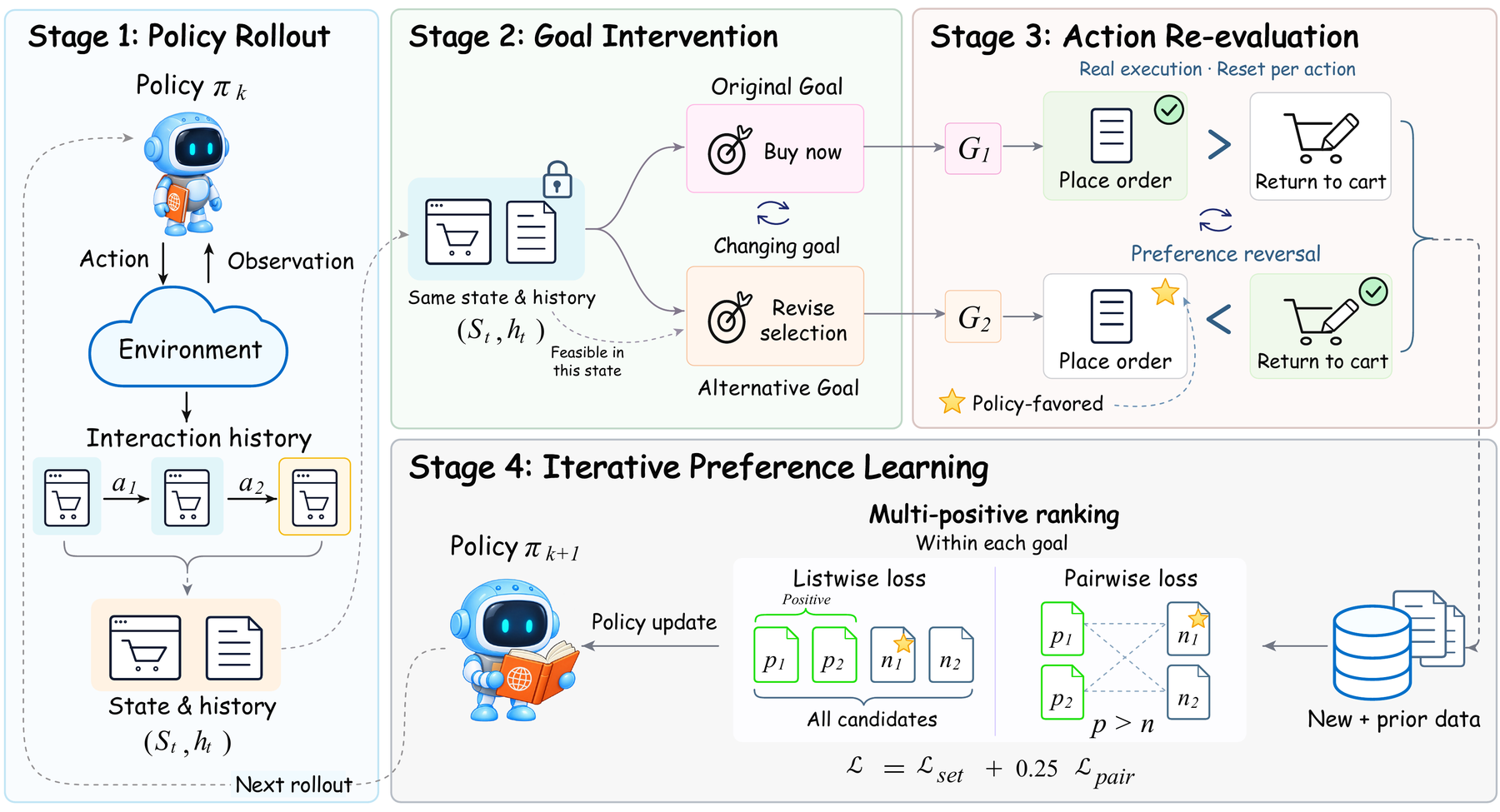
EVOKE is a post-training method that elicits the world knowledge already inside pretrained LLM agents, so that they decide by the consequences of their actions rather than by contextual habits — with no world-model module and no inference-time planning.
From acquiring world knowledge to eliciting it.
Large language models (LLMs) are increasingly deployed as agents for multi-step decision-making, yet transfer poorly to unseen environments. World-model methods address this by training agents to predict future observations, at the cost of additional training and errors that compound when predictions are used for planning. However, for LLM agents operating in digital environments, much of this world knowledge is already internalized during pretraining, which shifts the problem from acquiring it to eliciting it. We argue that typical post-training provides little pressure for such elicitation, since supervision under a single goal at each visited state inadvertently drives policies to rely on superficial contextual habits. We introduce EVOKE, a post-training method that supplies this pressure through goal diversity at fixed states. Motivated by theory showing that an agent competent across diverse goals must encode a world model recoverable from its action preferences, EVOKE holds the environment state and interaction history fixed and ranks the same candidate actions under alternative goals, forcing action preferences to change, so that a policy relying on contextual habits or single-goal correlations cannot order them correctly. This implicitly elicits the policy's pretrained world knowledge to inform decisions. We evaluate EVOKE across diverse tasks in three backbones, demonstrating improved task performance, unseen environment generalization, and data efficiency. We further conduct controlled analyses to better understand what drives these gains. These findings offer a new perspective on eliciting internalized world knowledge for transferable action through direct decision supervision.
Do agents need to predict consequences to use them?
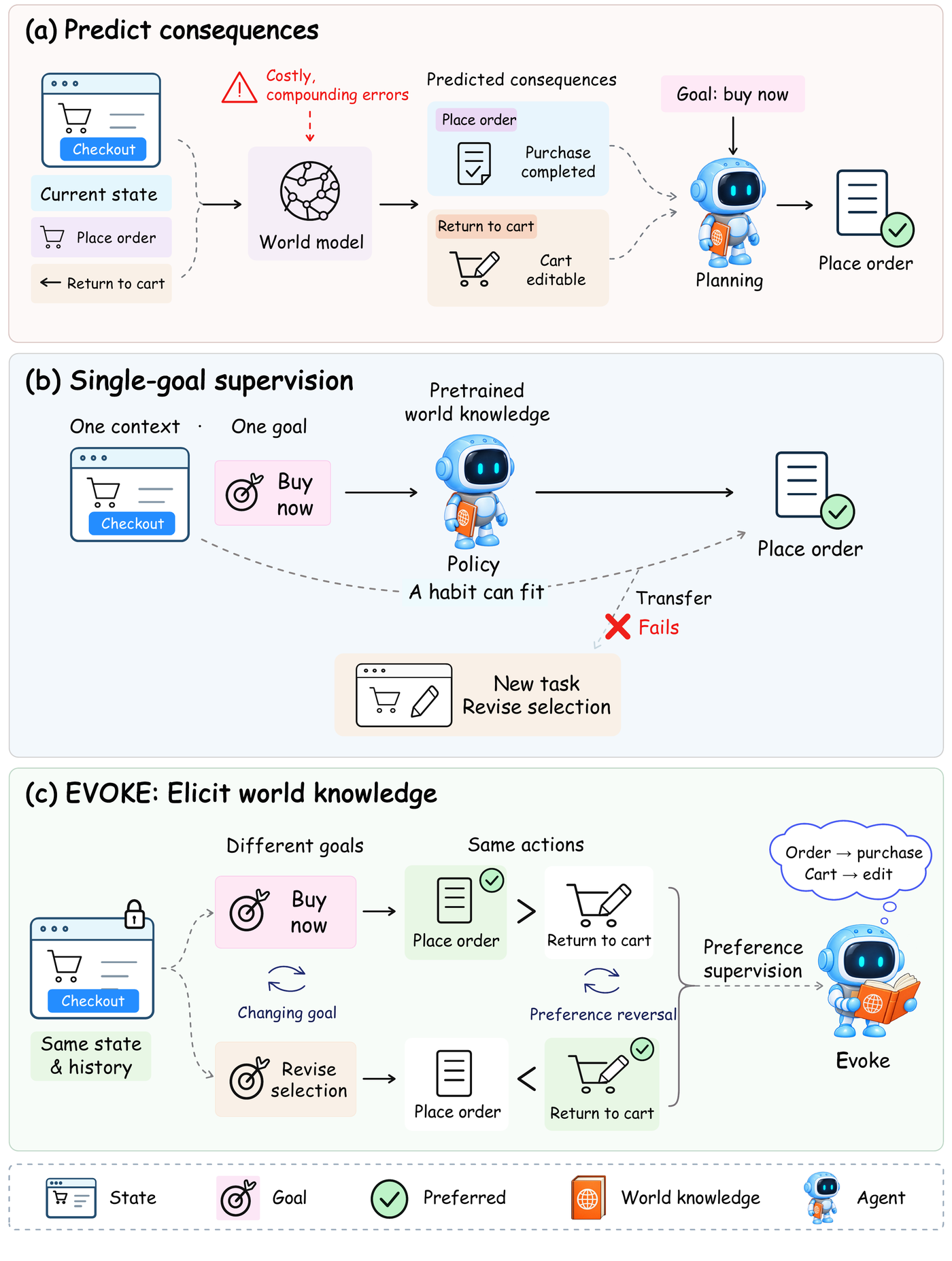
Predict consequences
World models learn to predict future observations, adding cost and compounding errors in planning.
Single-goal supervision
The knowledge is already in pretrained LLMs, but one goal per state lets the policy fit habits that fail to transfer.
EVOKE
Change the goal at a fixed state. Preferences flip, so habits fail and the policy must use its knowledge of consequences.
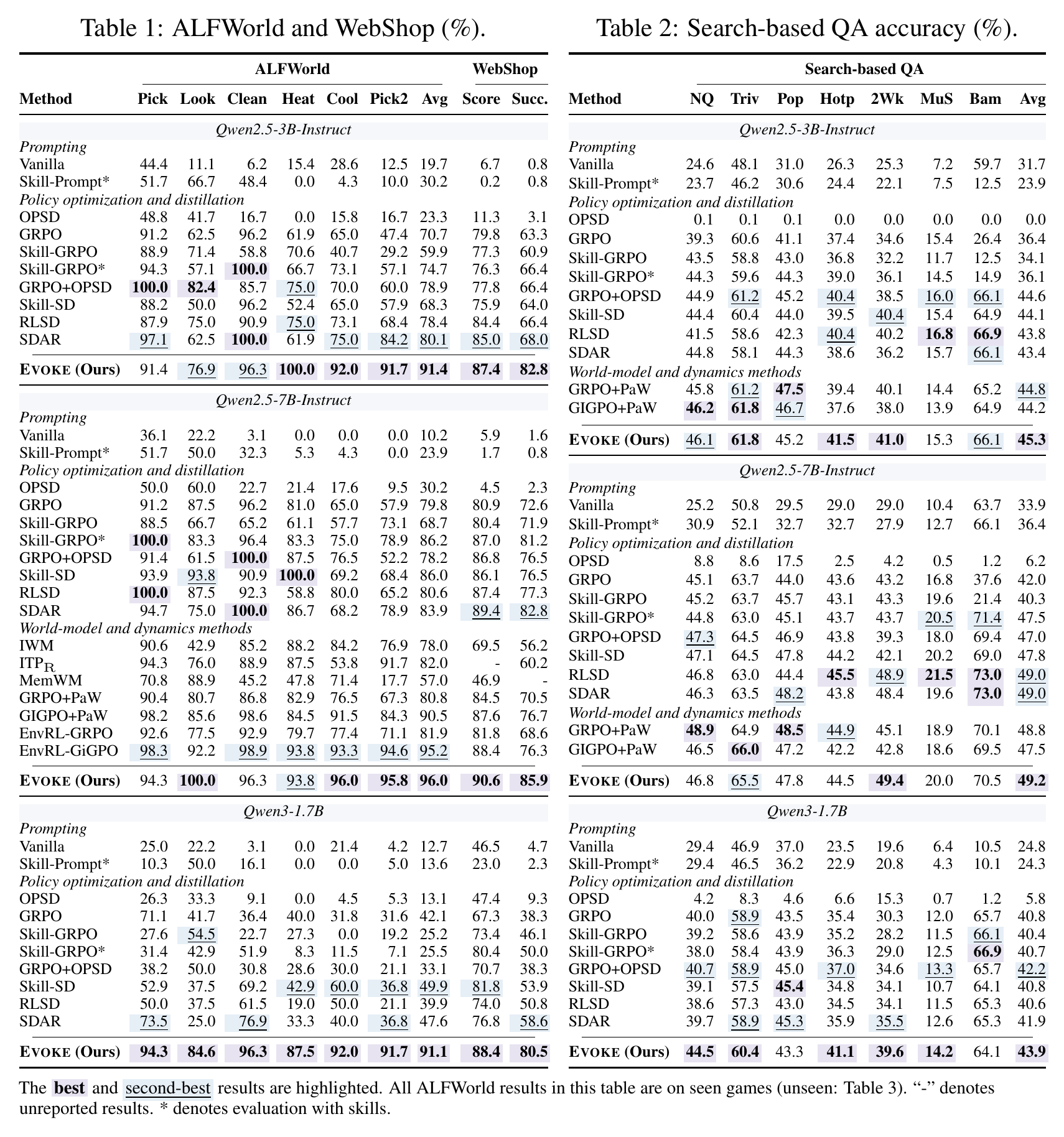
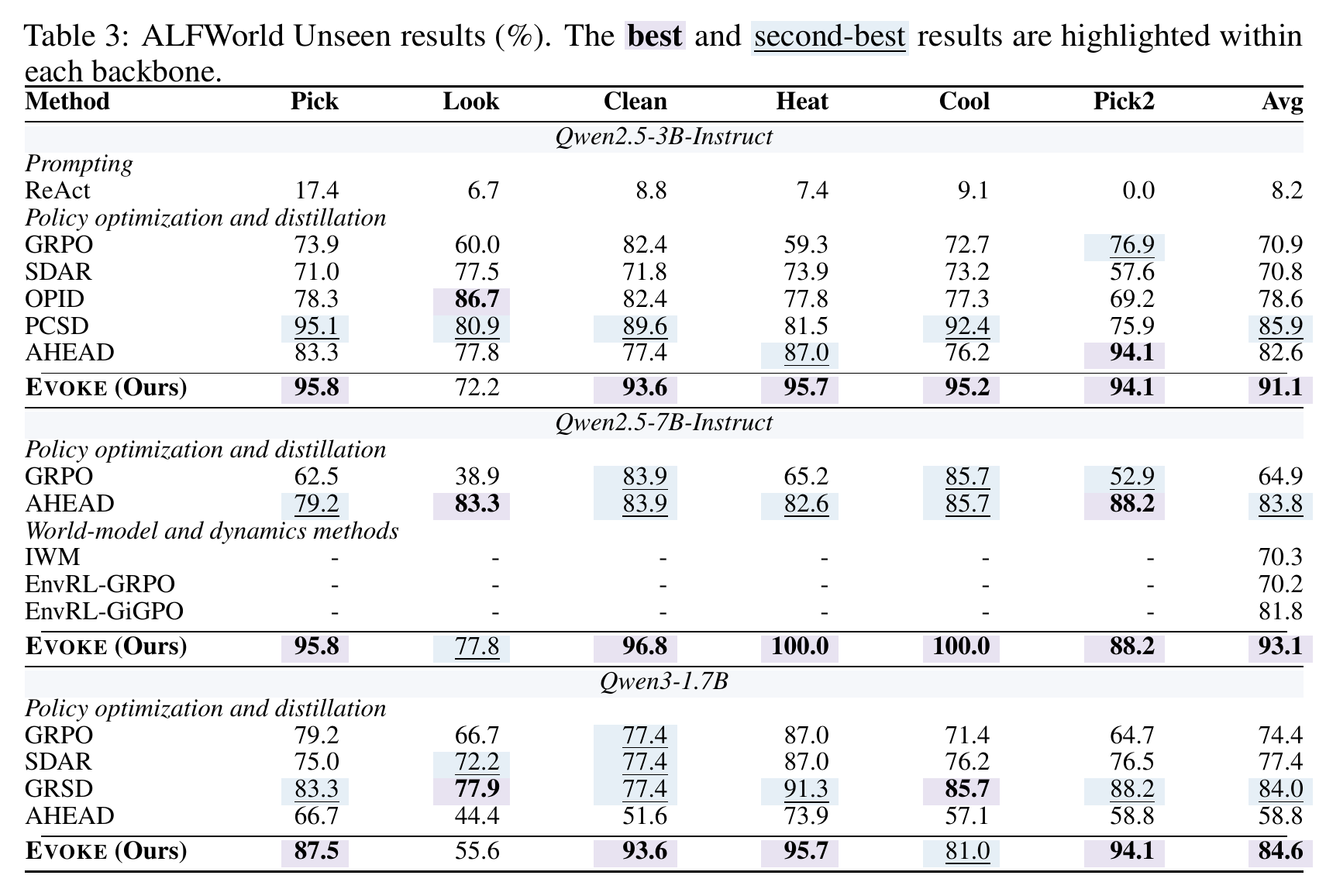
Best on every benchmark and backbone, and it transfers.
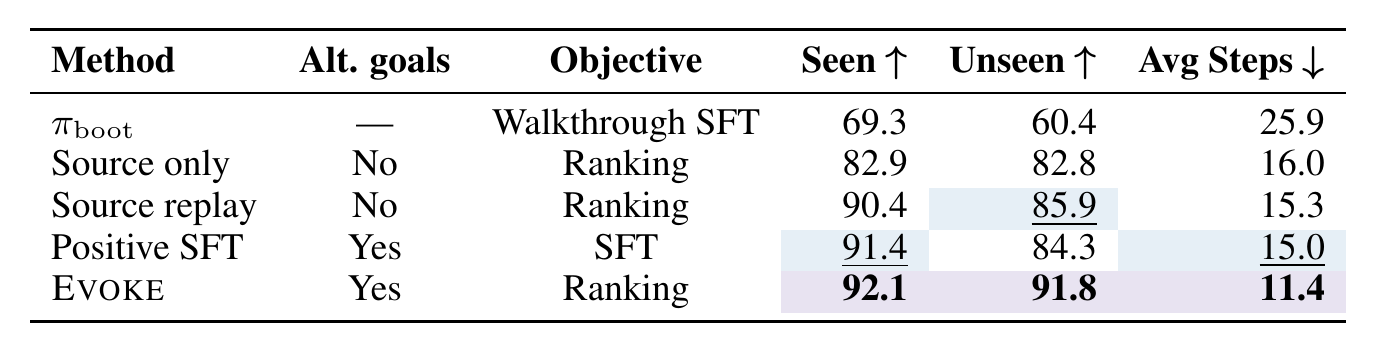
Average success on unseen ALFWorld games with Qwen2.5-7B.
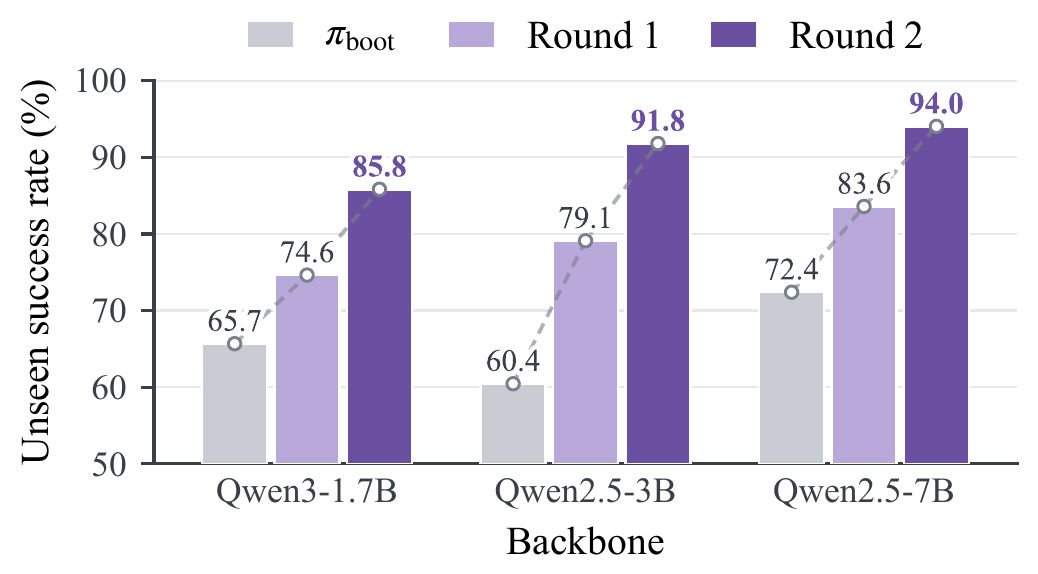
Unseen ALFWorld with Qwen2.5-3B; 84.6% with Qwen3-1.7B — best on each backbone.
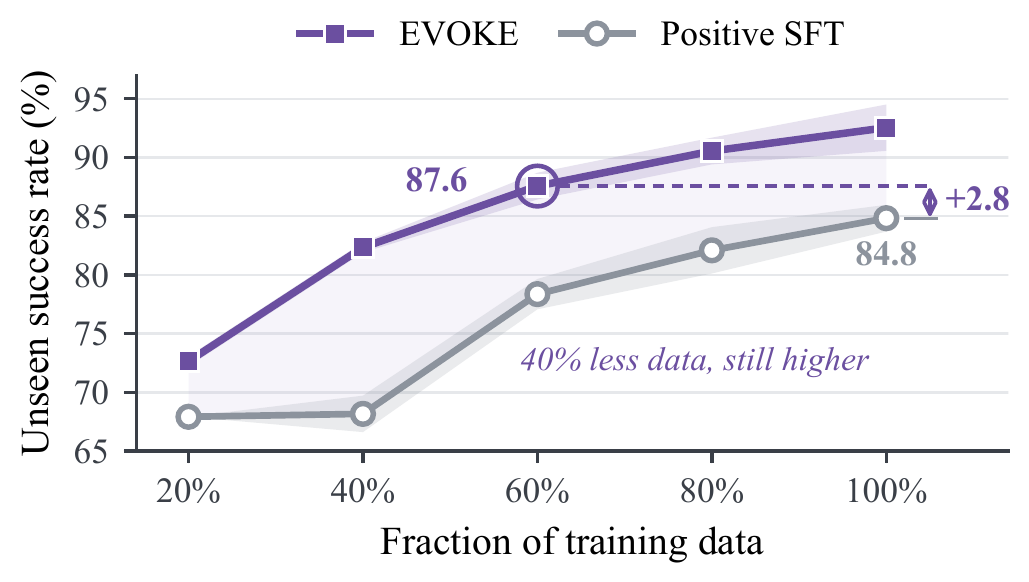
of the labeled states already let EVOKE beat SFT trained on all of them.
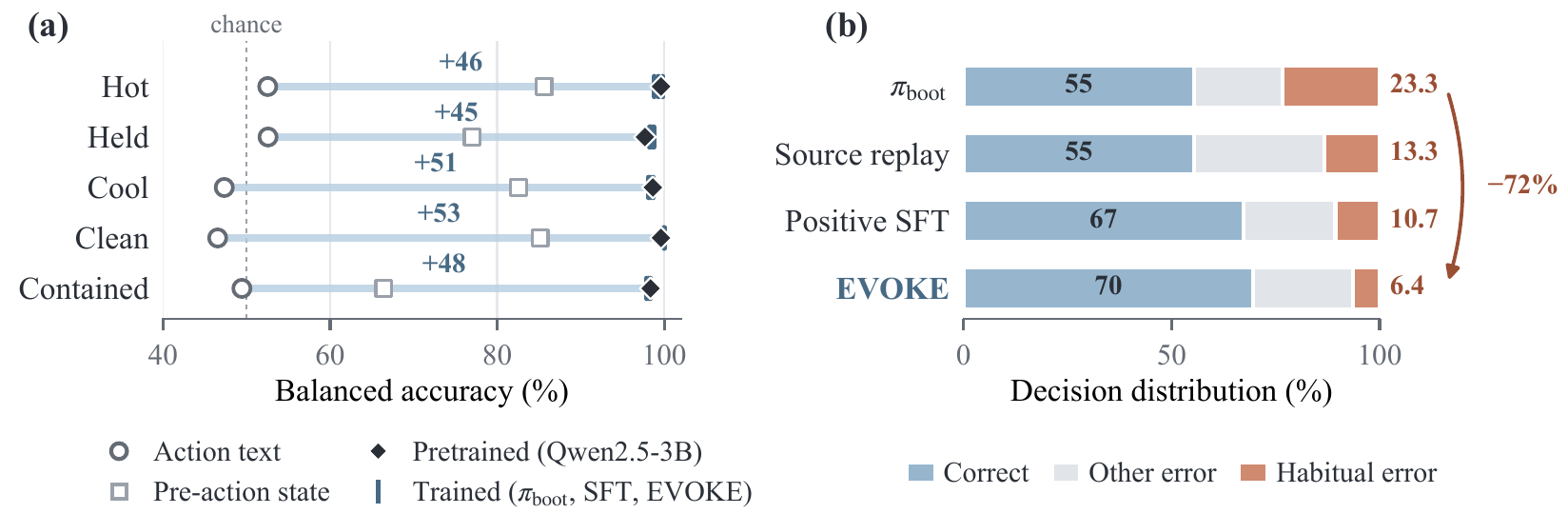
Habitual errors — the fewest of all variants on goal pairs that need different actions.
Where do the gains come from?
All analyses: Qwen2.5-3B on ALFWorld unless noted
Do the gains come from goal interventions?
YesRemoving alternative goals drops unseen success from 91.8% to 82.8%. Replaying the original-goal data for as many updates still reaches only 85.9% — it is not a matter of training longer.
Is more goal data enough? Does iteration keep helping?
Ranking winsImitating the same goal data falls 7.5 points behind on unseen games; ranking is ahead at every data budget. Each round of aggregation improves every backbone, raising unseen success by 20.1–31.3 points.
Is the knowledge already there, and does EVOKE use it?
YesAction consequences are almost perfectly decodable from the original backbone before any ALFWorld training, yet the walkthrough-initialized policy solves only 60.4% of unseen games. EVOKE decides by the goal rather than by habit, making the fewest habitual errors.
Better decisions, or more trial and error?
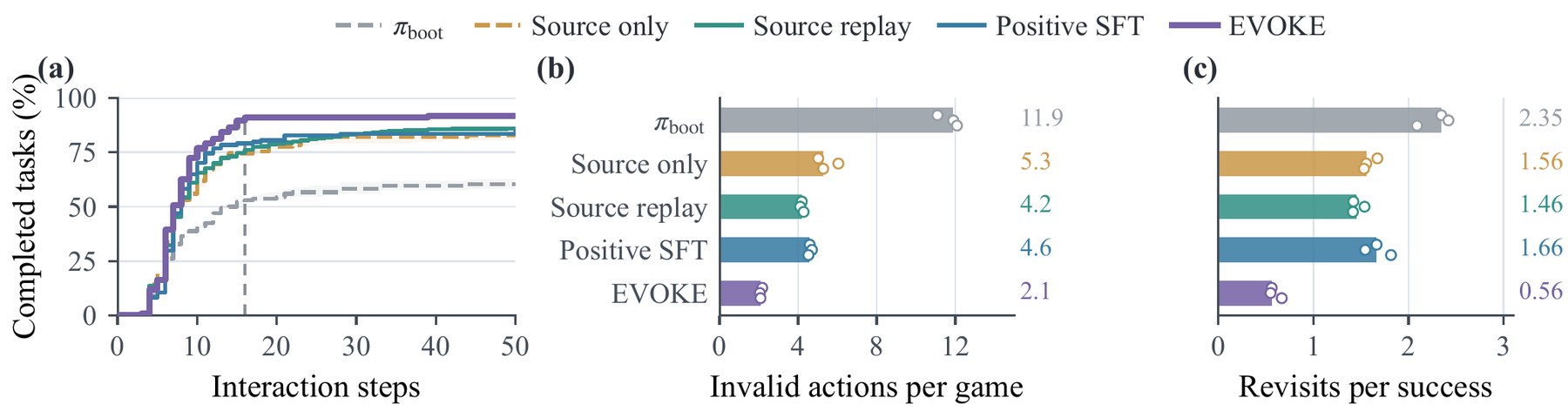
Better decisionsEVOKE solves 91.0% of unseen games within 20 actions and needs 24.4–28.9% fewer actions per game, with fewer invalid actions and revisits.
What's coming.
- Released
Paper
The full paper on arXiv.
- Released
Code
Evaluation code on GitHub; training code coming soon.
- Released
Models
Trained models on Hugging Face.
- Soon
Data
Goal-intervention preference data.
- Soon
Scripts
Reproducing the main results and analyses.
Cite EVOKE
@article{guo2026evoke,
  title={EVOKE: Eliciting World Knowledge in Agents for Transferable Decision-Making},
  author={Guo, Yuhan and Liu, Jinming and Xu, Liang and Li, Ziqiang and Huang, Jianguo and Wang, Zhicheng and Zhu, Hu and Chen, Qiuyu and Wei, Yuntao and Jin, Xin and Zeng, Wenjun},
  journal={arXiv preprint arXiv:2609.38334},
  year={2026}
}